What Hindu rituals to follow to make the most of Narasimha Jayanti
A simple guide to observing Narasimha Jayanti with calm devotion, covering easy puja steps, fasting choices, and the meaning behind the rituals without complexity.
Pigs, in general, do not enjoy much respect in modern society. An exception, however, is found in George Orwell’s story “Animal Farm,” where the pig is portrayed as an intelligent and persuasive animal who inspires other animals to aspire to a better future.




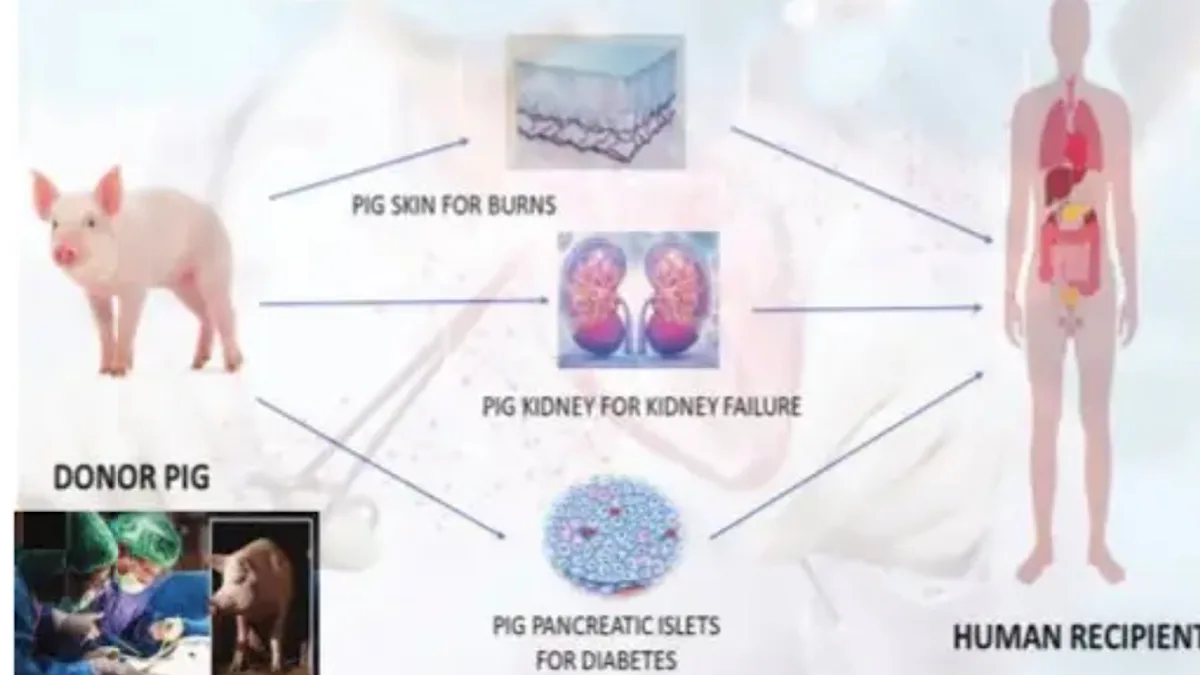
Photo:SNS
Pigs, in general, do not enjoy much respect in modern society. An exception, however, is found in George Orwell’s story “Animal Farm,” where the pig is portrayed as an intelligent and persuasive animal who inspires other animals to aspire to a better future. However, in Hindu mythology, the pig occupies a position of reverence. The boar or Varaha is worshipped as an avatar of Lord Vishnu. An avatar is believed to descend to Earth to protect righteousness and eliminate evil.
According to Hindu mythology, Lord Vishnu assumed the form of Varaha to rescue the Earth after the demon Hiranyaksha submerged it in the cosmic ocean. In recent times, the pig has re-emerged as an avatar of a different kind ~ one with the potential to save millions of human lives in urgent need of kidney transplants. Thousands of kidney patients die due to the lack of availability of suitable kidneys for transplant. The demand for kidney transplants for patients with acute renal failure has been increasing at a rapid rate in recent years, while the availability of donors is astonishingly small. According to current statistics, in India, an estimated 2,00,000 patients require kidney transplants every year. However, only about 4 per cent of them can finally have a kidney transplant, leaving a huge gap between supply and demand.
Advertisement
Bridging this gap only with human donors is impossible due to various ethical and medical issues. This shortage is not unique to India; globally, only about ten per cent of patients in need receive organ transplants. Addressing this crisis poses a formidable challenge for scientists and healthcare professionals worldwide. The primary alternative for survival in such cases is dialysis ~ a painful and demanding procedure. In conventional dialysis, one needle withdraws blood from the patient while another returns the filtered blood to the body. For dialysis to be effective, reliable vascular access is essential. However, dialysis cannot reverse kidney damage, and ultimately, transplantation remains the only definitive solution. For decades, scientists and medical professionals have been striving to resolve the global organ shortage.
Advertisement
Recently, a promising solution has emerged through the use of genetically modified pig kidneys, as reported in several major scientific publications. The transplantation of organs from one species to another is known as ‘xenotransplant’, originating from the Greek word ‘xeno’ meaning foreign or alien. It is to be noted that attempts at kidney xenotransplantation date back to the 1960s, with the groundbreaking research done by Professor Keith Reemtsma of Tulane University in the US, using kidneys of chimpanzees. One of the patients survived for about nine months, which was considered to be a feat at a time when their dialysis access was extremely limited. Pigs have emerged as the preferred source for xenotransplantation because their organs closely resemble human organs in size and structure. They are easy to obtain.
Pigs breed twice a year, sometimes thrice, with litters averaging eight to twelve piglets. Cloning (a process that creates a genetically identical copy of an organism, cell, or gene) of pigs is easily doable and their genomes can be edited by a pair of molecular scissors known as ‘Clustered Regularly Interspaced Short Palindromic Repeats’ or, in brief, CRISPR. Owing to these advantages, scientists believe that pig organs are the best source for human xenotransplantation to address the organ shortage crisis. Supported by advances in gene editing and immunosuppressive medicine, eGenesis, an American-based company, has demonstrated that its organs could survive for long periods in the bodies of primates. Genome editing or gene editing is a technique that enables changing an organism’s DNA (deoxyribonucleic acid).
In simple words, DNA is like an instruction manual for life processes. It contains all the instructions for building and running the life processes of all living things. It is a double-stranded, twisted ladder-shaped molecule that stays inside the nucleus. There is another kind of molecule known as RNA (ribonucleic acid) that also carries genetic information and helps carry out DNA’s instructions by making proteins, which are the building blocks of life. Gene editing operates much like editing a manuscript, correcting misspellings, deleting or replacing words, and enables the addition, removal, or alteration of genetic material at specific locations within the genome. There are other methods also available for gene editing, but scientists have found this method to be much faster, cheaper, more accurate, and more efficient than other methods.
In the initial phase, gene editing was performed on pig DNA to eliminate genes incompatible with the human immune system. Four such most problematic genes, GGTA1, CMAH, BG4ALNT2 and PERV, were thus removed from the DNA of the pig. The gene GGTA1 was removed because this creates an antigen that the human immune system rejects. Antigens, as we know, are substances that cause the immune system to respond when introduced into the body. If the immune system recognises an antigen as its own ‘self’ (similar to the body), it accepts it; if not, it attempts to eliminate. The gene CMAH produces a protein that humans cannot synthesize; the gene BG4ALNT2 creates an antigen on the cell surface that human immune systems attack; PERV is a viral gene found in all pigs and may cause diseases and tumours.
Seven human genes were then added to the sample’s DNA that will protect the edited kidney from inflammation, cell damage, and coagulation, tricking the human immune system into accepting the foreign organ. This edited DNA was then used to create embryos, which were implanted into surrogate pigs. This edited DNA was then used to create embryos, which were then implanted in a surrogate pig to give birth to a litter of piglets with two kidneys that are compatible for implantation in humans. After several laboratory tests of such kidneys, trial transplants were made on a brain-dead patient to understand whether the transplanted kidneys were working well. A brain-dead patient is legally dead, and one whose other physiological functions are maintained artificially. Only after successful outcomes, the Food and Drug Administration (FDA) of the USA allowed conducting a clinical trial of the procedure on three living patients to start with.
The first pig kidney transplant in a living patient was performed at the Massachusetts General Hospital (MGH) in the US in March 2024. But he died after 57 days due to cardiac arrest unrelated to the implant, as declared by the doctors. The second transplant was done in April 2024, but the patient died after three months because of heart-related issues. The third implant, done in January 2025, proved more encouraging, and the patient lived a normal life for about eight months. The pig kidney was removed in late October 2025 due to declining function. In January 2026, the patient successfully received a transplant of a human kidney from a living donor and is recovering well. This marked the first successful transition from a pig kidney transplant to a human kidney transplant in medical history.
This success has generated renewed optimism to extend this clinical trial to at least 50 patients in the next round. Although the long-term outcomes remain uncertain, and the ultimate success of xenotransplantation is yet to be established, these breakthroughs offer new hope for addressing the global shortage of human donor organs and for thousands of patients awaiting kidney transplants each year. If this surgical procedure turns out to be a success, then the pig may well be promoted to a higher echelon as an avatar in the modern world, saving millions of lives in distress.
(The writer, an author, was Editor-in-Chief of the journal Science and Culture for about two decades)
Advertisement